AC Replacement · 12 min read · October 24, 2026

A new central air conditioner in Phoenix in 2026 typically lands around $9,000 to $13,000 installed for a complete split-system replacement, with the full range running roughly $6,500 to $18,000+ depending on tonnage, SEER2, ductwork and electrical work. A rooftop package unit can come in lower: one Valley installer published $7,195 for a 3-ton single-stage package unit, crane included, in October 2026. Every quote starts from the same floor, because a new split AC installed in Arizona must meet 14.3 SEER2 under 45,000 Btu and 13.8 SEER2 at or above.
Most of that spread can be read off the quote itself. We take a price apart the same way when we build one for AC replacement in Glendale and across the Valley: system type, size, efficiency, refrigerant, the house, and what SRP still pays back. If you want to see a real replacement start to finish first, read how a failing Glendale split system was replaced in 112F heat.
Five things set most of the price: whether the house has a split system or a rooftop package unit, the tonnage, the efficiency tier, whether the indoor coil and ducts have to change, and what the house itself adds. A Sun City home (median year built 1973, per Census data) or an older West Valley block home is likely to have a package unit on a flat or foam roof. A 2000s tract house in Peoria or Surprise is more likely to have a split system, with the condenser on a side-yard pad and the air handler in the attic, a hall closet or the garage.
Then come the line items nobody sees until the old unit is off: ducts that leak or were undersized, an electrical whip or disconnect that no longer meets code, a roof curb that does not line up with the new cabinet, and a crane when the unit lives on the roof.
The right size comes from a Manual J load calculation, the ACCA method that adds up the heat a house gains through its roof, walls, windows and ducts, and not from the label on the old unit. One ton is 12,000 Btu per hour of cooling. Sizing by habit has a long history here: an APS-sponsored field study of new Phoenix homes in the 1990s found the standard heat-gain calculation of the day overestimated the cooling load by about 50 percent. Alex runs a load calculation on every replacement quote for that reason, and SRP requires one with every single-stage Cool Cash application, with the capacity within 15 percent or half a ton of it.
Manual J sizes to Phoenix's design temperature, not to the hottest afternoon of the year. On a 115F day a correctly sized system can run nonstop and let the house drift a degree or two above setpoint by early evening, which is how it was designed to behave. A nominal 3-ton condenser also delivers less than 36,000 Btu per hour at 110F outdoors, and the manufacturer's expanded performance table shows how much less. Residential systems top out at 5 tons, so a large or two-story Valley house often runs two systems, and its quote prices two.
Because the federal rule for the Southwest, in force since January 1, 2023, draws its line for split-system air conditioners at 45,000 Btu per hour of certified capacity, which is 3.75 tons. Below that line the floor is 14.3 SEER2 and 11.7 EER2. At or above it, the floor is 13.8 SEER2 and 11.2 EER2. A unit rated 15.2 SEER2 or higher needs only 9.8 EER2 at either size. Most nominal 4-ton and all 5-ton systems certify above the line (the AHRI certificate decides), so a 4-ton or 5-ton condenser can legally carry a lower rating than a 3-ton.
Arizona sits in the Department of Energy's hot-dry Southwest region with California, Nevada and New Mexico. Since January 1, 2023, a split-system AC installed here must meet 14.3 SEER2 under 45,000 Btu per hour and 13.8 SEER2 at or above, plus the EER2 floors above. A package AC has a 13.4 SEER2 national floor and a 10.6 EER2 floor in the Southwest. For split ACs, the rule follows the installation date, and the DOE's own guidance says installing a noncompliant unit in the region is illegal.
Above the floor, every major brand sells the same three compressor tiers: single-stage (on or off), two-stage or multi-stage, and variable-speed (inverter). Trane lists air conditioners from 13.4 up to 23.6 SEER2 across single-stage, multi-speed and variable-speed lines. Rheem's Endeavor Line steps from the Select and Classic series up through Classic Plus and Prestige, with Prestige models rated up to 20 SEER2. Rheem also marks its RA13NY as meeting northern-region standards only, the kind of model that cannot go in an Arizona yard. Goodman's current lineup runs from the single-stage GLXS models (up to 15 to 16.5 SEER2) to the two-stage GLXT7C and the inverter GXV6S and GXV9S, rated up to 19 SEER2.
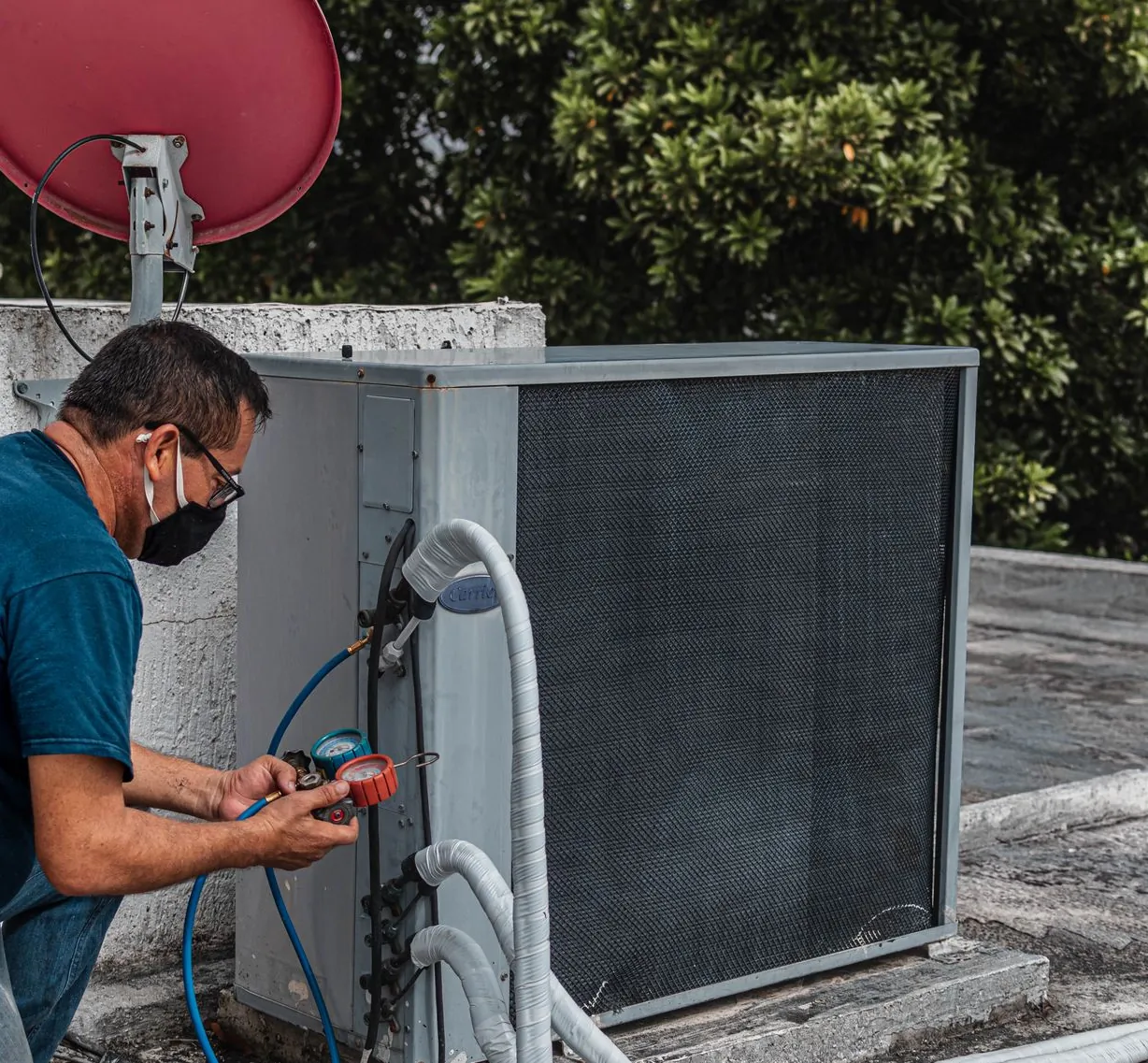
On the equipment, often yes. A package unit is one cabinet with no separate indoor coil or air handler to match, and the one published Valley price we found, $7,195 for a 3-ton single-stage package unit with crane service, sits below the typical split-system range. What a package swap adds is the roof: the crane, a curb adapter when the new cabinet does not line up with the old opening, and a reseal of the penetration before the monsoon. In summer, a rooftop crane day starts at first light, because by midday a foam roof is no place to work. Our rooftop package unit replacement story walks through a West Valley crane day and the curb adapter that job needed.

City rules can differ by system type too. Phoenix exempts the repair or replacement in kind of an outdoor unit of 5 tons or less at a one- or two-family home when the new unit weighs the same, but any replacement of equipment inside the house needs a permit, which puts most split-system change-outs on the permit side. Glendale's building Q&A says a residential AC replacement needs no permit when a licensed contractor installs it (both cities checked October 2026).
It changed what a replacement includes more than the sticker. Since January 1, 2025, new residential AC systems must use a refrigerant under 700 GWP, so Carrier, Lennox and the Trane split in our Glendale story run on R-454B, while Goodman's current air conditioners use R-32. EPA lists both as A2L (mildly flammable) refrigerants, and most ducted R-454B systems carry a refrigerant leak sensor at the indoor unit: Lennox's installation guide says every system charged with at least 4 pounds of R-454B needs one. The new outdoor unit also has to be matched to a new indoor coil or air handler, so a split replacement means a new matched pair, outdoor and indoor.
EPA's May 26, 2026 reconsideration rule removed the installation deadline for systems built entirely from R-410A components made before 2025, so some quotes may still offer leftover R-410A equipment. In a house with a gas furnace, the furnace can often stay while the coil on top of it is replaced. Our Glendale replacement story explains R-454B in plain terms.
Plan on about $9,000 to $13,000 installed for a typical complete split-system replacement in the Phoenix metro. Each line below moves it up or down from there.
| Line item | Typical Phoenix range | What moves it |
|---|---|---|
| Complete split-system replacement, typical | $9,000 to $13,000 installed | Tonnage, SEER2, matched coil or air handler, ducts, electrical |
| Complete split-system replacement, full range | $6,500 to $18,000+ installed | Small single-stage systems at the bottom; variable-speed, new ducts and electrical at the top |
| Like-for-like AC and furnace swap (published Valley rate) | $8,000 to $12,000 installed | Same size, standard efficiency, existing ducts |
| Two-stage ducted system (published Valley rate) | $12,000 to $16,000 installed | Compressor tier and controls |
| Variable-speed system (published Valley rate) | $16,000 to $22,000 installed | Inverter compressor, communicating controls, duct upgrades |
| 3-ton single-stage rooftop package unit | $7,195 installed, crane included (one published price) | October 2026 Valley release; curb adapter and roof sealing vary |
| New ductwork (national figure) | $3,600 to $9,500 installed | Length of the runs, attic access, how badly the old ducts leak |
| City of Phoenix residential permit, when required | $195 minimum per permit | Plus $12 for each $1,000 of valuation from $1,001 to $10,000 |
The split-system range comes from our Glendale replacement story, the published Valley rates were read October 22, 2026, the ductwork figure is from a national cost guide, and the Phoenix fees are from the city fee schedule effective January 20, 2026. A written estimate on site is free.
The published tier prices cover an AC and a furnace together, so an AC-only or heat pump job can land lower in each band. The package-unit price comes from one installer's launch release, so treat it as one company's benchmark.
Less than you could a year ago, and it depends on your utility. SRP customers can still claim SRP Cool Cash: $75 per ton for a single-stage system, $150 per ton for multi-stage and $225 per ton for variable-capacity, all at 15.2 SEER2 or higher and listed in the AHRI directory, installed by an Arizona-licensed contractor before April 30, 2027 and filed within six months (as of October 2026). On a 3-ton system that is $225, $450 or $675. Split systems must replace both the air handler and the condensing unit, and garages and new construction do not qualify.
APS no longer lists residential AC or heat pump rebates on aps.com (checked October 22, 2026). In December 2025 the Arizona Corporation Commission cut APS's energy-efficiency budget to $40 million, and the Cool Rewards thermostat program continues. The federal 25C credit is gone for equipment placed in service after December 31, 2025. Income-qualified households can check Efficiency Arizona, which lists up to $8,000 for a heat pump for households under 150 percent of area median income ($168,600 for a family of four in Maricopa County). Its site warns of significant program changes, so confirm eligibility before you sign.
Enough to compare two quotes line for line and to file a rebate without chasing paperwork:
We put every one of those on paper at a free estimate, and we will gladly look at another company's quote next to ours. Our finished replacements are in the project gallery.
Most complete split-system replacements in Phoenix land around $9,000 to $13,000 installed, with the full range running roughly $6,500 to $18,000+, but square footage will not tell you where a house falls in that range. Two 2,000 square foot houses can need different tonnage depending on roof, windows, insulation and ducts. A Manual J load calculation sets the size, and the size sets most of the price. A rooftop package unit can come in lower: one Valley installer published $7,195 for a 3-ton single-stage unit with the crane included.
Not always. On a split system with a gas furnace, the AC's coil sits on the furnace. The new R-454B or R-32 system needs its own matched coil, but a sound furnace can usually stay. Ask for the AHRI rating that matches the furnace you keep, because an AHRI certificate covers a specific condenser and coil, and often a specific furnace. SRP's Cool Cash checklist (as of October 2026) asks for the coil and furnace model numbers and says both the indoor air handler and the condensing unit must be replaced on split systems, so confirm a kept-furnace job with the Electric League of Arizona at (602) 264-3108 before counting on the rebate.
Before the first 100-degree day if you can. The NWS Phoenix average first 100F day is May 2, and from then until October a dead system is an emergency rather than a decision. Fall and winter replacements leave time for a load calculation, two or three quotes and a rebate application. SRP customers should note the Cool Cash deadline: the system has to be installed before April 30, 2027, and the rebate filed within six months of installation.
Usually because they are not quoting the same system. Compare the tonnage and the load calculation behind it, the compressor tier (single-stage, two-stage or variable-speed), the certified SEER2 and EER2 on the AHRI certificate, whether the indoor coil or air handler is replaced, the refrigerant, and what each quote includes for ductwork, electrical, a crane or a curb adapter. Once those match, the gap between quotes usually shrinks to labor, warranty registration and brand.
Un reemplazo completo de un sistema split en Phoenix suele costar entre $9,000 y $13,000 instalado, y el rango completo va de unos $6,500 a más de $18,000 según el tonelaje, el SEER2, los ductos y el trabajo eléctrico. Una unidad paquete de 3 toneladas en el techo se publicó en $7,195 con la grúa incluida. Llámenos o mándenos un texto al 480-853-6627 para un presupuesto gratis. Se habla español.
A replacement day already has the power off, the closet or attic open and sometimes a crane booked, so these add-ons are quoted together on the same visit:
Text us a photo of your old unit's rating plate and we will tell you what a replacement will need, or call 480-853-6627 for a free estimate anywhere in the Valley. Request a free estimate online if you would rather write.
Get a free, no-pressure estimate from a licensed local pro. Call or text and we'll get you scheduled fast.