Valley Homes · 12 min read · October 23, 2026

Replacing an AC in Sun City or Sun City West often means a rooftop package unit on a low-slope roof, a crane on the street for the lift, and Maricopa County instead of a city as the permit office, because both communities are unincorporated. The county exempts an outdoor unit replaced in kind (5 tons or less, same spot, same or lower weight) and its June 2024 fee summary lists $50 for a minor self-service AC permit. Roof-mounted work that goes to technical review can cost more. One published Valley price for a 3-ton rooftop package unit with the crane included is $7,195 installed. The best months to do it are October through April, while snowbirds are home to make the decisions.
The Sun Cities are their own corner of the Northwest Valley: Del Webb streets off Bell Road and Grand Avenue, single-story homes, golf courses, recreation centers and a population that is partly here for the winter. Replacing an AC there involves a few things a Glendale tract home does not. For the equipment and the work itself, see our AC installation and replacement page.
Because of how and when they were built. Census figures put the median Sun City home at 1973 and the median Sun City West home at 1989, and many of the older homes are single-story slab houses with block walls and flat or low-slope roofs that leave little attic for an air handler. With no basement and little attic, an all-in-one package unit on the roof, with the ducts dropping straight down, was the simple answer.
That shapes the replacement. A package unit holds the compressor, both coils, the blower and, on a gas pack, the burners and heat exchanger in one cabinet, so the whole cabinet is replaced at once, usually by crane. Our walkthrough of a West Valley rooftop package unit replacement covers the curb adapter, the duct transition and sealing the roof against the monsoon.
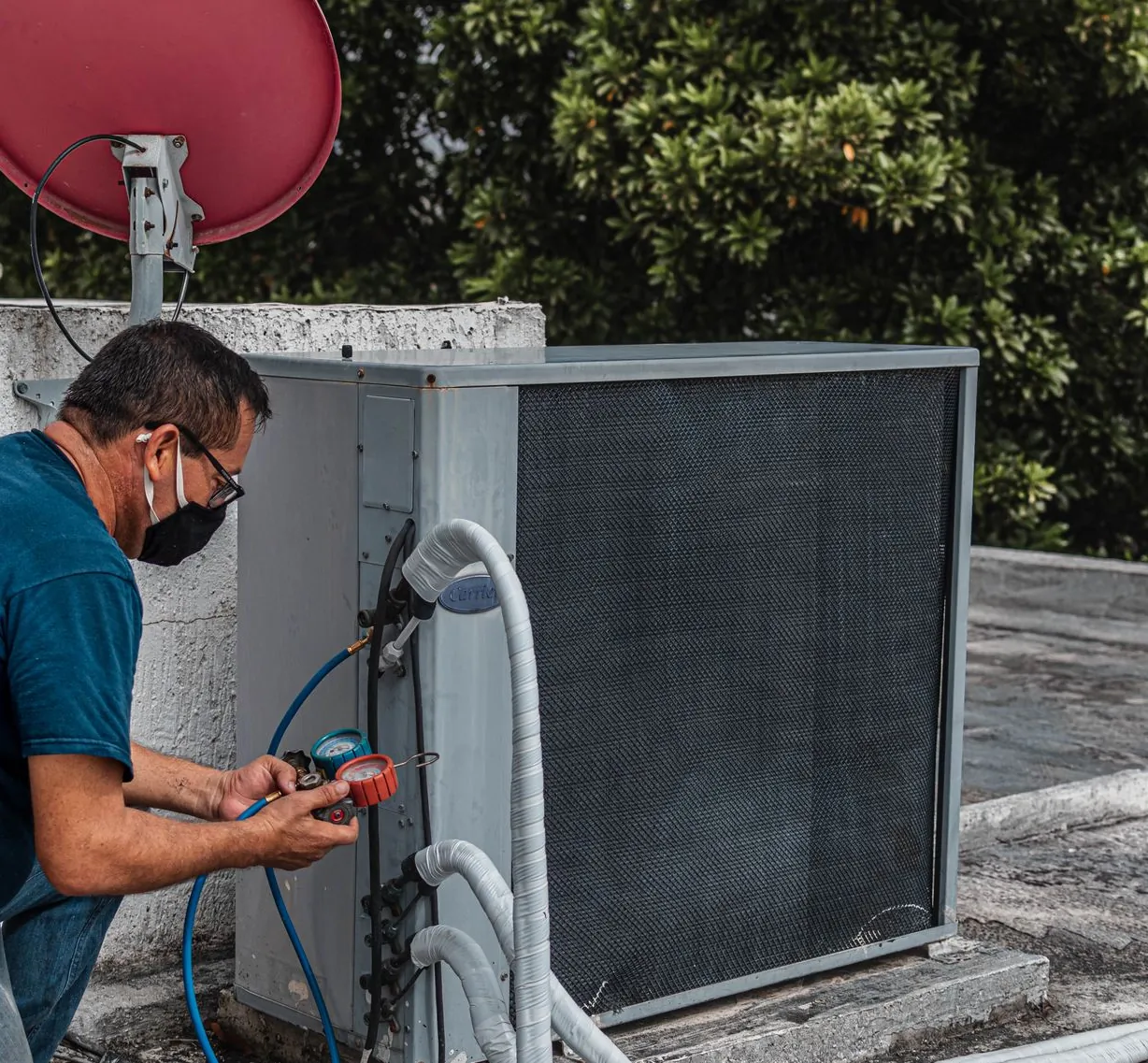
An older system may still run on R-22, and that alone does not force anything. EPA's homeowner fact sheet says U.S. production and import of R-22 ended on January 1, 2020, but "you may continue to use HCFC-22 in your existing system for as long as necessary." The data plate on the unit names the refrigerant, and it is the first thing Alex Saenz, our owner and lead technician, reads on an older rooftop unit, because the refrigerant and the build date frame every option after that.
What changes the math is a leak. Every recharge of an R-22 system draws on reclaimed stock, and a unit that needs refrigerant every summer has a coil or a fitting that is failing. When it is time to replace, the new equipment will not be R-410A either: that refrigerant was phased out for new manufacture as of January 1, 2025, and new systems use A2L refrigerants, most often R-454B, with a GWP around 466 versus roughly 2,088 for R-410A (Goodman and Daikin equipment uses R-32). New R-454B and R-32 units carry a refrigerant leak sensor that shuts down the compressor and runs the blower if it detects a leak (typical; confirm the model). Our repair-or-replace walkthrough lays out how to weigh a big repair against a new system.
In Sun City, the deed restrictions (CC&Rs) are mandatory for single-family homes and the Sun City Home Owners Association enforces them. Membership in SCHOA is voluntary, but following the CC&Rs is not. The restated CC&Rs we read (May 12, 1998) list no design-review step for replacing an AC in the same spot. Two rules touch the job. Section 11.A says equipment "shall be kept screened by adequate planting so as to conceal them from view of neighboring lots, streets or golf course property," which matters if equipment moves to the ground, and section 10.B says construction machinery is removed "immediately upon completion." Moving equipment, adding a ground unit or changing what the neighbors see is where to call SCHOA first, since it can grant variances. The Recreation Centers of Sun City, which run the rec centers and golf courses, are a separate organization from SCHOA. Condos have their own CC&Rs and boards.
In Sun City West, the CC&R Department of the Recreation Centers of Sun City West enforces the rules, and it acts on complaints rather than patrols. Its brochure counts more than 100 different CC&Rs across the community, so request yours before the crane is booked. PORA, the Property Owners and Residents Association, states that it is not a regulatory or enforcement agency, and it offers members vendor referrals. If your home sits inside a separate condo or patio-home HOA, that board's approval is the one to get in writing.
Sometimes. Sun City and Sun City West are unincorporated, so Maricopa County Planning and Development is the building department. The county's local amendments exempt the "repair or replacement in kind of refrigeration units not over 5 tons of refrigeration capacity when located outdoors, in the same location and equal to or less than the weight of that which is replaced."
Work outside that exemption needs a permit. The county issues a "Mechanical Repair/Replace Like for Like" permit online, while "Roof-Mounted A/C, Evaporative Cooler, HVAC" work goes to technical review with a site plan. The county's fee summary dated June 2024 lists $50 for a minor self-service air conditioner permit. Roof-mounted work that goes to technical review can cost more, so confirm the fee with the county. Once a permit is issued the inspection is scheduled through the county's Permit Center or at 602-506-3301. A heavier new unit, a bigger one, or one in a new spot falls outside the exemption, so ask whoever quotes the job which path your replacement takes. These rules were checked on the county's pages on October 22, 2026.
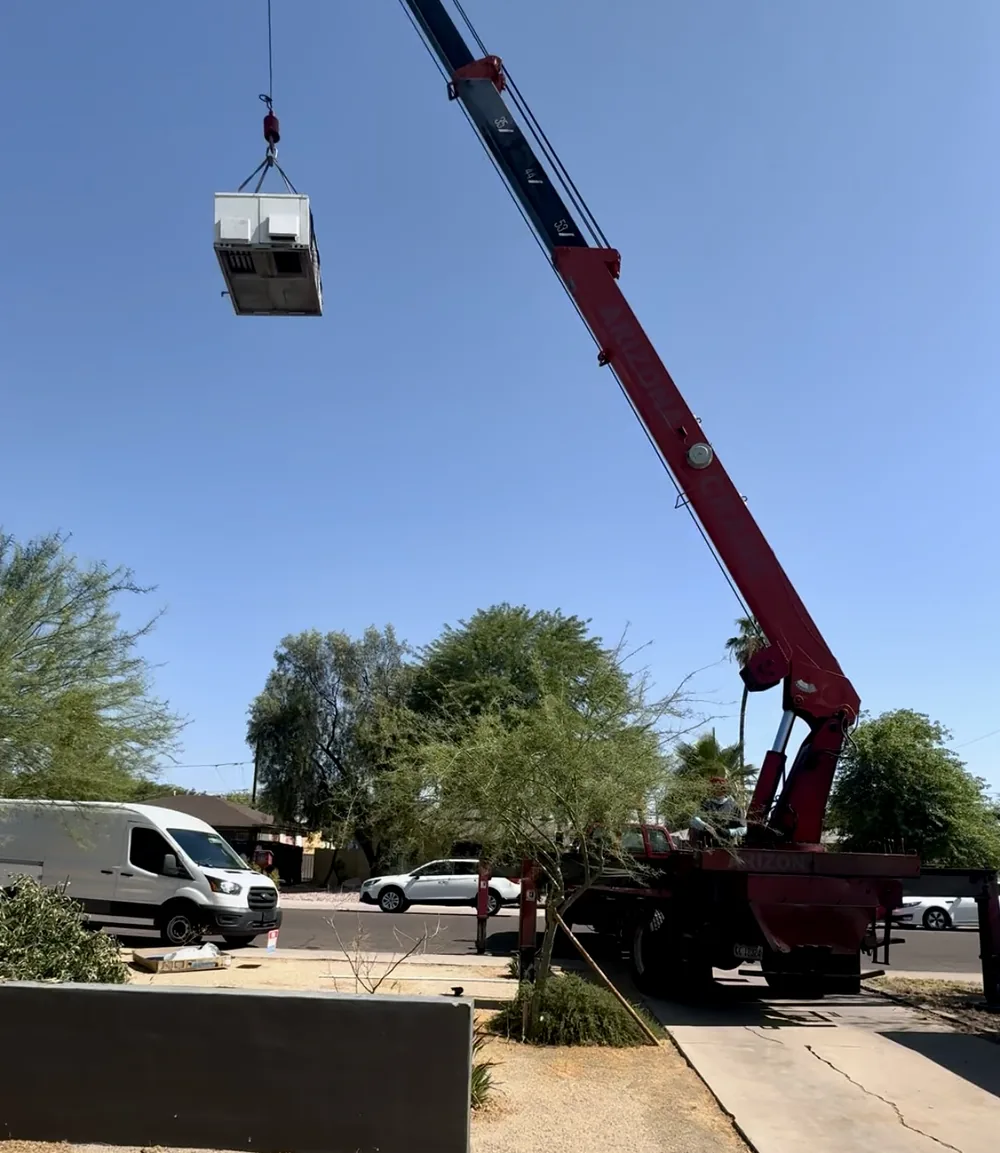
Most of crane day is the work around the lift (a typical sequence; the details vary by job). Before the lift, the tech shuts off power and gas and recovers the old unit's refrigerant into a recovery cylinder. That is EPA Section 608 work, and refrigerant is never vented. The electrical, gas, drain and duct connections come off, the crane lifts the old cabinet, the curb is checked and re-flashed or a curb adapter is set and sealed, and the new unit goes on.
After the set come the duct connections sealed at the curb, the gas line leak-tested and the flue checked on a gas pack, a trapped condensate drain, and the disconnect. On a low-slope roof the drain should run toward a scupper or roof drain, not onto the coating beside the curb where it ponds. A package unit arrives charged from the factory, so commissioning means confirming the charge by superheat and subcooling, checking amp draw, airflow and the temperature split, and on a gas pack the gas pressure and the burner.
The crane parks on the street in front of the house, and on a golf-course lot it usually reaches over the house from the street. The operator checks the overhead service lines before setting up. OSHA's crane rule (29 CFR 1926.1408) keeps the boom 20 feet from power lines unless the utility confirms the voltage. Neighbors' cars may need to move while it is set up, and a quick word next door the day before keeps that easy.
Plan for weight and for working hours. A modern cabinet can weigh more than the one it replaces, which is a question for the roof framing and for the county's in-kind exemption. Older installs sometimes sit on wood sleepers, or on a stand with a sheet-metal "doghouse" over the duct drops instead of a curb, and the replacement is the time to fix that (typical). On hours, the Sun City West CC&R page (checked October 2026) lists residential construction start times of no earlier than 5 a.m. from April 15 to October 15 and 6 a.m. from October 16 to April 14, with work done by 7 p.m. An early start keeps a summer roof job out of the worst heat.
Expect roughly the Valley's going rate for the same equipment, plus what the Sun Cities add: the crane, possibly a curb adapter, and sometimes a county permit ($50 for a minor self-service AC permit). One published Valley price for a 3-ton rooftop package unit with the crane included is $7,195 installed, and published Valley ranges for a complete system run $8,000 to $22,000.
| Line item | Typical Phoenix range | What moves it |
|---|---|---|
| 3-ton rooftop package unit, crane included | $7,195 installed (one published Valley price) | Tonnage, gas pack or heat pump, curb adapter |
| Complete system, published Valley rates | $8,000 to $22,000 installed; like-for-like $8,000 to $12,000 installed | Single-stage, two-stage or variable speed; ductwork |
| Split system (condenser and matched coil) | Around $9,000 to $13,000 installed; roughly $6,500 to $18,000+ overall | Tonnage, SEER2, ductwork, electrical upgrades |
| Maricopa County AC permit, when one is needed | $50 per minor self-service permit (June 2024 fee summary) | Whether the swap falls under the in-kind exemption; technical review for roof-mounted work |
| Diagnostic visit before deciding | $89 to $98 per visit | Whether it is credited toward the repair |
| Tune-up on a system you are keeping | $100 to $250 per visit | Roof access, coil cleaning, number of systems |
Published Valley rates, the split-system range from our replacement post, and Maricopa County's fee schedule, read October 22, 2026. Replacement estimates are free; ask what a repair visit costs when you call.
On an SRP account, Cool Cash pays $75, $150 or $225 per ton for a qualifying system at 15.2 SEER2 or higher installed before April 30, 2027. APS no longer lists AC equipment rebates on aps.com (both checked October 22, 2026).
Between October and April, while you are here. Census counts show about 10 percent of Sun City's housing units and 9 percent of Sun City West's are held for seasonal use, against about 3 percent countywide, so a lot of these roofs sit over empty houses from May to October.
The calendar argues for winter. Phoenix's first 100F day averages May 2, and in 2024 the city logged 70 days at 110F or hotter against a normal of 21. A 20-year-old unit that quits in July with nobody home is found late, often by a neighbor or a house checker, during the busiest weeks for every crane and crew in the Valley. A swap in February is scheduled around your calendar instead. If you keep the old unit one more year, book a tune-up before you head north, so the capacitor and the drain line get looked at while someone can still act on what the tech finds.
For income-qualified owners, yes. Maricopa County's Emergency Home Repair program covers air conditioning and heating repairs and replacement for households at or below 80 percent of area median income (from $62,950 for one person to $118,700 for eight, effective June 1, 2026). Owners must have owned and lived in the home as their primary residence for a year, households with someone 62 or older get priority, and unincorporated communities such as Sun City and Sun City West fall inside the county's service area. The number is 602-506-0589.
The state's Weatherization Assistance Program, run through the Arizona Department of Housing, tests and tunes heating and cooling equipment for income-eligible households, and SRP's rebate page notes it replaces cooling equipment in some cases.
The 1998 restated CC&Rs we read list no design-review step for replacing an AC in the same spot. Section 11.A requires equipment to be screened by planting from neighboring lots, streets and golf course property, which matters if equipment moves to the ground, and construction machinery must be removed when the work is done. Moving equipment, adding a ground unit or changing what the neighbors see is where to call SCHOA first. SCHOA enforces the CC&Rs and can grant variances. Condos have their own CC&Rs and boards, so condo owners should ask their association first. SCHOA's office is at (623) 974-4718.
The Recreation Centers of Sun City West run the CC&R Department, and it responds to complaints rather than patrolling. Its brochure counts more than 100 different CC&Rs in Sun City West, so request your own at [email protected] or (623) 544-6661. PORA, the Property Owners and Residents Association, says on its own site that it is not a regulatory or enforcement agency, and it advocates for residents and offers members vendor referrals. Homes inside a separate HOA follow that HOA's rules as well.
Yes, though it costs more each year. EPA's homeowner fact sheet says U.S. production and import of R-22 ended January 1, 2020, and that reclaimed R-22 plus stock made before 2020 serves existing systems. EPA also warns about R-22a, a flammable hydrocarbon blend falsely sold as an R-22 substitute. It is not an acceptable replacement. If the unit keeps needing refrigerant, the leak is the real repair, and on an old package unit that is often where replacement starts making sense.
Look at the name on your electric bill. It matters for rebates: SRP's Cool Cash pays $75, $150 or $225 per ton for qualifying systems at 15.2 SEER2 or higher installed before April 30, 2027, while APS no longer lists AC equipment rebates on aps.com (both checked October 22, 2026). If you are not sure, both utilities publish service-area maps and address lookups on their websites.
When a permit is issued, yes. The county's construction permit page, checked October 2026, says to schedule a building inspection through its online Permit Center or by calling 602-506-3301 once the permit is out. A replacement that falls under the county's in-kind exemption needs no permit and no inspection. Homeowners doing their own work can apply as an owner-builder for their own use, under the conditions on the county's application.
A crane day is the cheapest time to handle anything else up top. These fit the same day and get quoted together on the same visit:
Text us the model number from an old invoice, or a photo of the unit taken from the ground (please do not climb onto the roof for it), and we will tell you what you have, or call 480-853-6627 for a free estimate in Sun City or Sun City West. Request a free estimate online if you would rather write.
Get a free, no-pressure estimate from a licensed local pro. Call or text and we'll get you scheduled fast.